
About Us
The Nagasaki Museum of History and Culture opened on November 3, 2005, in the forest surrounding Nagasaki’s Suwa Shrine.
The Museum is situated on the historical grounds of the former Nagasaki Magistrate’s Tateyama Office. A section of this important Edo period site has been meticulously reconstructed and is open to the public. The reconstruction was guided by extensive historical research, utilizing Edo period maps and excavated artifacts.
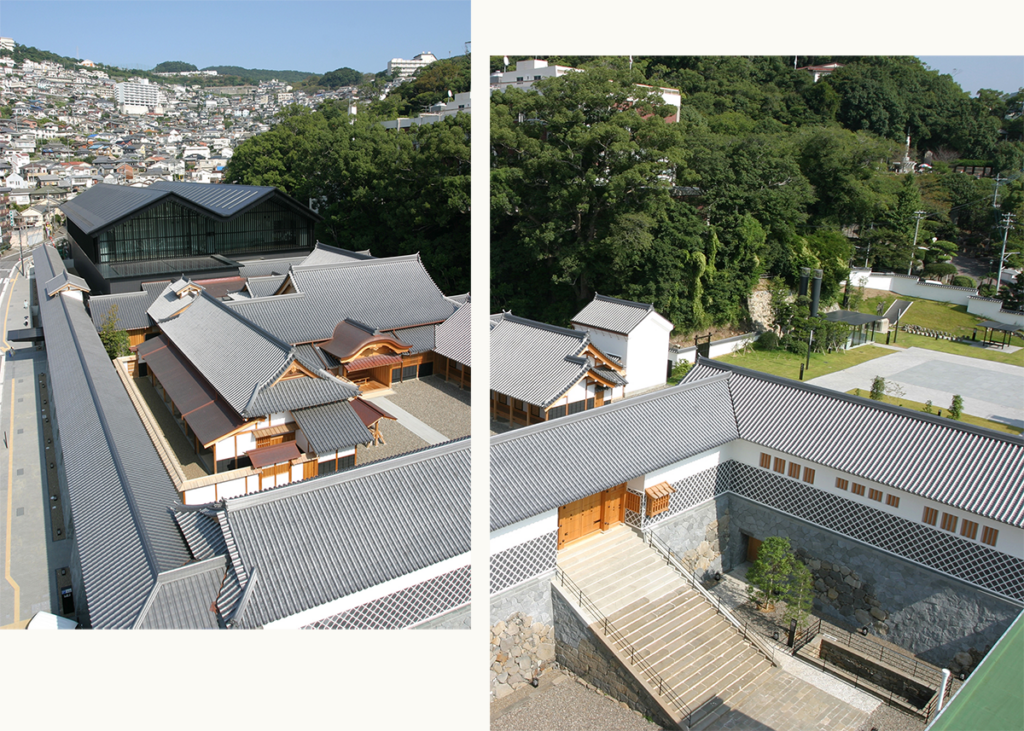
The exhibition area is divided into two main zones: the “Historical and Cultural Zone” and “The Japanese Government of Nagasaki Zone”. The Historical and Cultural Zone delves into the rich history of overseas exchanges in early-modern Nagasaki. It presents a multi-faceted exploration of Nagasaki’s vibrant past, from the Age of Exploration to exchanges with Korea, China and the Netherlands, the Nagasaki trade, until the end of the Edo period and the Meiji era. The Japanese Government of Nagasaki Zone features the reconstructed Nagasaki Magistrate’s Tateyama Office, and offers an insightful look into the historical role of the Office in an easy-to-understand manner. Exhibits include the “Hankachō”, a collection of judicial decisions from the Edo period, artifacts related to the Hidden Christians, and skits that reenact actual trials once held in the Oshirasu, the court of law of the Edo period.
The Museum is affectionately nicknamed “Rekibun” in Japanese, rather than the more common “Rekihaku”. This choice emphasizes Nagasaki’s rich history (“rekishi”) of overseas exchanges and unique culture (“bunka”).
Experience the unique history and culture of Nagasaki at Rekibun.
Message from the Director for 2026
Dr.Eiji Mizushima
Director General

On November 3rd of last year, our museum proudly celebrated its 20th anniversary. This milestone would not have been possible without your warm support and cooperation, for which I extend my heartfelt gratitude. Since our opening in 2005, we have worked hand in hand with the people of Nagasaki to preserve and share the city’s rich history and culture, while serving as a hub for nurturing local heritage. Over the past two decades, we have hosted more than 200 exhibitions and provided educational programs for all generations—from children to seniors—creating countless opportunities for learning and engagement.
An International Reach Rare for a Regional Museum
Reflecting Nagasaki’s unique character as an international city, we have welcomed visitors from 69 countries to date. For a regional museum, this level of global diversity is exceptional. It is clear evidence that the appeal and message of our museum resonate far beyond Japan’s borders, and that Nagasaki’s cultural heritage continues to inspire across nations.
This international presence is more than a statistic—it lays the foundation for future collaborations, multilingual educational programs, globally inclusive exhibitions, and citizen-driven initiatives that connect Nagasaki to the world.
Preserving Cultural Heritage and Driving Regional Impact
Our commitment to conserving and restoring cultural assets ensures that Nagasaki’s invaluable historical treasures are passed on to future generations. These efforts have also generated significant economic benefits for the region. According to estimates by the Nagasaki Regional Policy Research Institute, our museum’s economic impact over the past 20 years amounts to approximately 40.3 billion yen—about 2 billion yen annually. When combined with the contributions of the Nagasaki Prefectural Art Museum, the actual impact is likely even greater. This demonstrates a powerful truth: culture rooted in the community can become a driving force for regional vitality. It is a testament to the “Museum Power” shared by Nagasaki Prefecture, Nagasaki City, and our cultural institutions.
“Nagasaki in the World” and “The World in Nagasaki”
Historically, Nagasaki served as a gateway where Eastern and Western cultures converged—a role it continues to play today as a city of diverse values and global connections. Guided by our core theme of “Overseas Exchange History,” we strive to be a Global Museum: firmly grounded in local heritage while engaging in dialogue with the world. Our collaborations with countries such as the Netherlands, Portugal, Italy, China, Korea, Indonesia, and Vietnam exemplify this vision.
Our mission is twofold: to delve deeply into local history and to open doors to global perspectives. This belief shapes everything we do.
Looking Ahead to the Next 20 Years
The role of a cultural institution is not only to safeguard the past but also to envision the future. As we step into the next 20 years, we aim to become an open center of knowledge, serving as a cultural bridge between Nagasaki and the world.
We will shine a light on overlooked themes, strengthen partnerships with scholars in Nagasaki and abroad, and advance initiatives such as innovative exhibitions, enriched educational programs, systematic collection and archiving of regional materials, and citizen-led projects. Every suggestion we have received—from exhibition design to multilingual accessibility and visitor experience—will guide us toward meaningful improvements and creative solutions.
Evolution, Deepening, and True Value
Culture connects people, nurtures communities, and illuminates the future. Upholding the vision of our founding director, Tetsu Ohori—“a museum that evolves”—we now seek to deepen that experience and move toward renovation and innovation. Our ultimate goal is to realize the true value—the essence—of what this museum can offer.
Rooted in Nagasaki’s history and culture, we will continue to walk alongside our community while reaching out to the world. We sincerely ask for your continued support and partnership in this journey.